
BalancedWx Special: Challenges for the NWS
The recent IT/comms outage during a severe weather outbreak helps reveal the difficulties the agency is facing
When I shared on social media my Wednesday newsletter about the NWS IT/comms failure Tuesday evening that led to serious delays in the dissemination of severe weather warnings during a high end severe weather episode, I had several people who are familiar with NWS operations ask me “why was an upgrade of the national AWIPS (NWS operational IT/comms system) authorized in the middle of a severe weather outbreak.”
This is obviously a fair question, as the NWS has procedures by which “critical weather days” (CWD) are declared. This procedure is outlined in NWS Instruction 10-2203:
A CWD event is defined as an event that is occurring or is expected to occur within the NWS’ area of responsibility such that the NWS should eliminate or reduce unnecessary actions that might affect its ability to produce and disseminate essential products. The NWS’ area of responsibility is defined as the United States and other geographic areas for which the NWS provides weather support (including U.S. territories, etc.), international areas under the responsibility of the National Centers for Environmental Prediction (NCEP) Center (as a World Meteorological Organization Regional Specialized Meteorological Center), and the Earth near-space environment. Examples of events which warrant the declaration of a CWD include, but are not limited to, the following:
a. A widespread severe thunderstorm or tornado outbreak;
b. A storm system causing widespread, major precipitation (e.g. heavy rain, heavy snow, freezing rain, or blizzard conditions);
c. A tropical storm system;
d. A significant non-weather event (e.g., wildfire, large-scale disaster, high-profile public gathering, etc.)
While a severe weather outbreak was obviously in progress on Tuesday afternoon and evening — the severe weather system in question was designated a derecho by the Storm Prediction Center — a critical weather day was not declared. As the NWS instruction outlines, the National Centers for Environmental Prediction (NCEP) Senior Duty Meteorologist (SDM) — who is kind of like the chief meteorologist overseeing high level NWS operations 24x7 — is responsible for each day issuing a 3-day outlook for anticipated CWDs. This was the Tuesday morning notice:
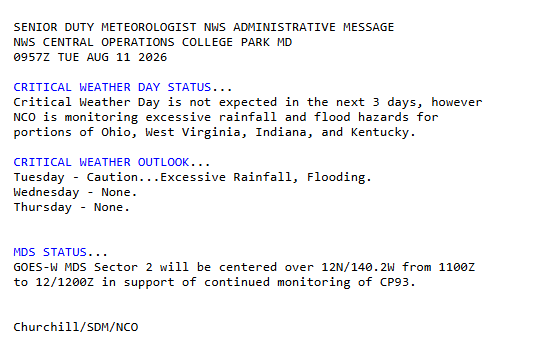
As you can see, the SDM did not even mention severe weather in their discussion — even though the SPC outlook they would have been looking at had an enhanced (level 3 of 5) risk for the Ohio Valley that highlighted the potential for a complex of storms producing a swath of 75+ mph gusts Tuesday afternoon. Of course, there was also serious flash flooding that occurred Tuesday into Tuesday night — and the potential for that was mentioned in the SDM discussion.
Why exactly Tuesday was not declared a critical weather day — which apparently allowed this AWIPS upgrade to proceed that eventually resulted in a national NWS comms outage during the severe weather episode — is unclear. I was in NWS operations long enough to know that there are a lot of factors — some meteorological, some non-meteorological —that go into decisions like this. Obviously, all I can see is the high level meteorological situation — I do not know the details on all of the other potential issues that went into the decision.
What I do know is that it can be tempting to blame individuals for failures like this — as an example in this case, the SDMs working in the lead up to the event. Similar blame games can be played after missed warnings and forecasts — of which there have been a number in recent weeks and months being discussed in the weather community — with NWS forecasters taking the “hit.” Of course, in some specific situations individuals do play a role (sometimes a major one) in operational failures. My experience though tells me that more often than not an organization’s culture and leadership play the biggest role in major operational failures as there are typically multiple “root causes.” From everything I hear from colleagues still in the NWS, the organizational culture and leadership of the NWS is not currently in a good place.
While it may be tempting to blame these organizational issues on recent budget and staffing cuts by the current administration, the reality in my opinion is that those factors are only one part of a bigger story. As I have discussed in numerous prior posts, the NWS has been chronically underfunded for decades in comparison to its continually growing labor bill, and needed organizational changes have consistently been punted down the road, leaving the NWS in a crisis situation. Certainly the DOGE/OMB cuts since early 2025 made this situation worse — but they were not the root cause.
Those cuts did force the NWS to make some major organizational changes in the last 18 months. Whether due primarily to pressure from political appointees or simply poor leadership and organizational culture, these changes from my perspective have been poorly communicated both internally and externally. The NWS is in the process of making a massive structural change to the agency in which the regional headquarters offices that long managed budget, IT, facilities and operations for the agency are going away, being replaced by a national support framework. However, unless I have missed something, this change has not been communicated in a consistent, organized fashion with the broader weather enterprise — hopefully that will change soon.
It is not just external communication though — everything I hear from talking to colleagues still in NWS indicates that the internal communication of all of this is poor. For example, I posted above the NWS Instruction from their Directives that are supposed to serve as the official internal guidance for all NWS operations and administration. Many of these Directives will obviously be affected by the organizational changes currently happening. However, they have not been updated and in asking a number of NWS employees about it off the record, I have basically been told that people are unsure whether the Directives are technically still in force or what the plan for them is. Essentially, it almost seems to me from the outside that the agency is operating without clear, written guidance.
Another example of the confusion that permeating the agency is with jobs and roles. This new organizational structure means that a number of NWS staff will have new roles and/or be reporting to new supervisors. In talking to people who attended the recent American Meteorological Society conference in Madison last month, they reported that conversations with NWS employees there revealed a number of people who were still unclear as to what their jobs were going to be (currently were?) and where they fit in the new organizational structure.
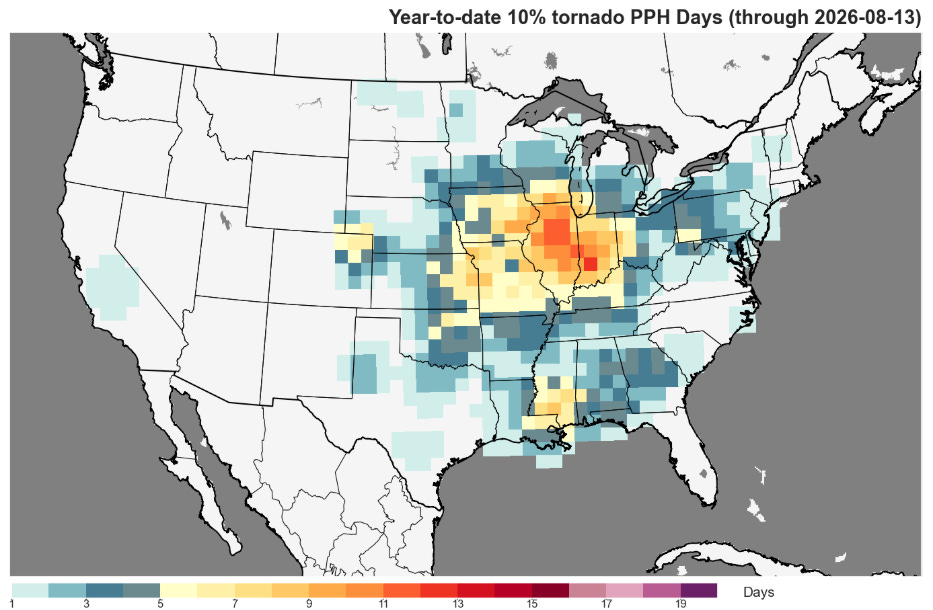
I want to finish this post talking about my concerns for NWS field forecasters and technicians. This graphic from the National Severe Storms Lab shows the number of days in 2026 in which a 10% “perfect probability hindcast” (PPH) for tornadoes occurred, i.e. essentially the number of days for which the actual number of tornadoes in a given area would have justified an enhanced (level 3 or 5) or higher Storm Prediction Center risk. You can see that the national bullseye is over the Midwest, with values as high as 12 days.
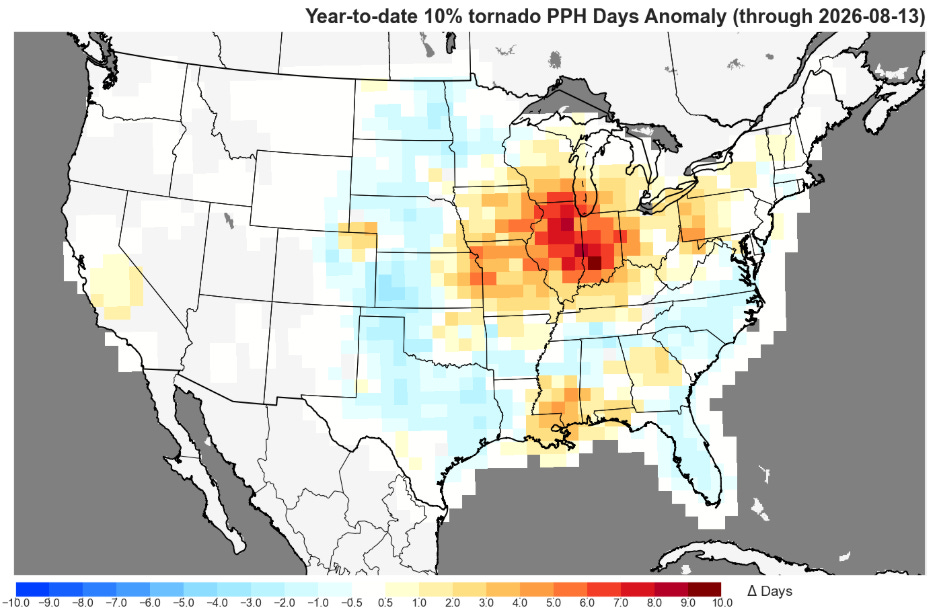
We can also look at the anomaly for these days, and can see values from southern Wisconsin into Indiana of 6 to 9 days, i.e., the NWS offices in these areas have been dealing with 2 to 3 times the number of serious tornado days than normal. Most of this has occurred in the last 3 to 4 months. It is important to understand that each one of these events takes a toll on an NWS staff. It is not just putting out the warnings during the actual severe weather episode — it’s days of intense activity.
First you have the stress of forecasting the event in the lead up to it, and then literally days of NWS staff having to drive hundreds of miles doing damage surveys, talking to people who have been impacted and in some cases have loved ones who were injured or killed. Dealing with this active of a severe weather season is hard enough when the NWS is in “normal” times with “normal” staffing. It is incredibly harder when the agency is in a period of turmoil and staffing is reduced.
Even though NWS leadership has been trying to restaff offices, from talking to people there are a number of offices in the Midwest that remain down several operational staff. When you only have an operational staff of 15-25 people, even just a handful of vacancies is very impactful. People I talk to report morale issues as operational staff are sometimes having to work overtime shifts to deal with busy weather or damage surveys on just a few hours of rest. Obviously, in situations like this typical activities like training, research and outreach are curtailed, which potentially further diminishes the NWS’ efficacy.
As I have talked about many times before, I know enough about the people in the NWS to know that all of them believe strongly in the NWS mission and want the agency to meet it in the best way it can. I do not write all of this with the intent to cast blame or throw stones — I do it because I think it is important for our weather community and the public to understand the challenges this critical agency is facing in the hopes that things can be improved. A record El Nino with all of the impacts that portends is anticipated in the coming months — we need an effective NWS.
I will have a post and/or video update about all of the weather going on across the country — including Tropical Storm Lala which will likely impact Hawai’i as a hurricane this weekend — later today.
Balanced Weather is made possible by the generous support of paid subscribers, who as thanks get access to live Balanced Weather chats and videos as well as the ability to post comments and ask questions on posts. To become a paid subscriber or a free subscriber (also very much appreciated and you will automatically receive new posts in your email), please click below.